
A handout circulated at the October 19 council meeting asking seven questions about Margaret’s finances and leadership. I wasn’t given a copy, but if someone has legitimate questions, I’m happy to provide them.
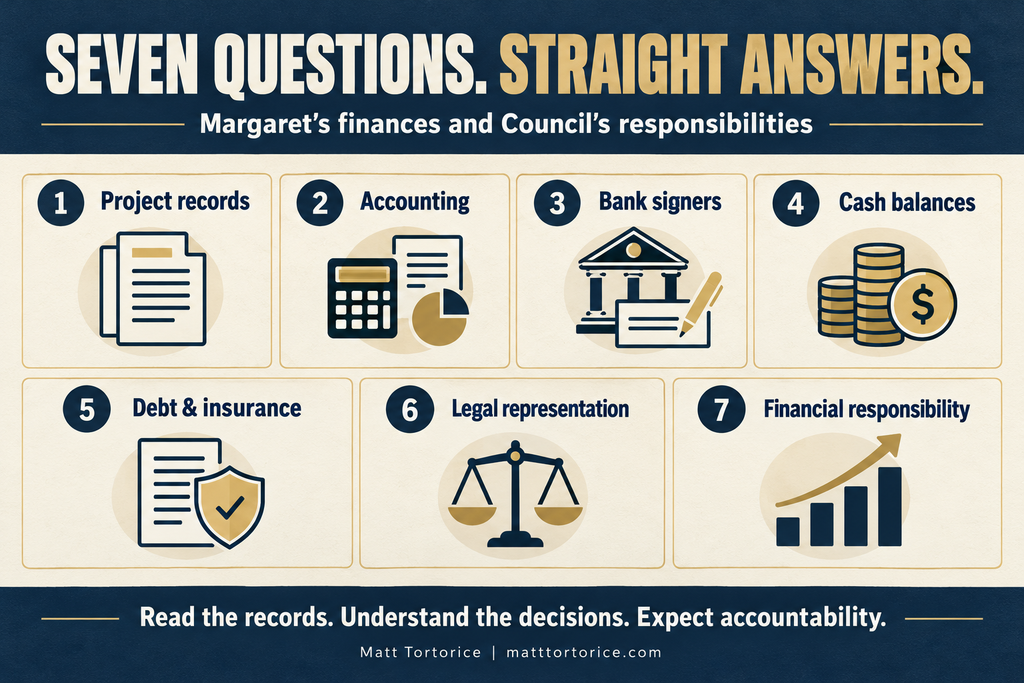
Several concern subjects I have already addressed publicly. Others require an explanation of municipal accounting, project funding and the responsibilities of the mayor and council.
Residents should feel comfortable asking questions. Council also has a responsibility to review the records, understand the processes and help provide accurate answers.
Here is the document that was passed out in Council.
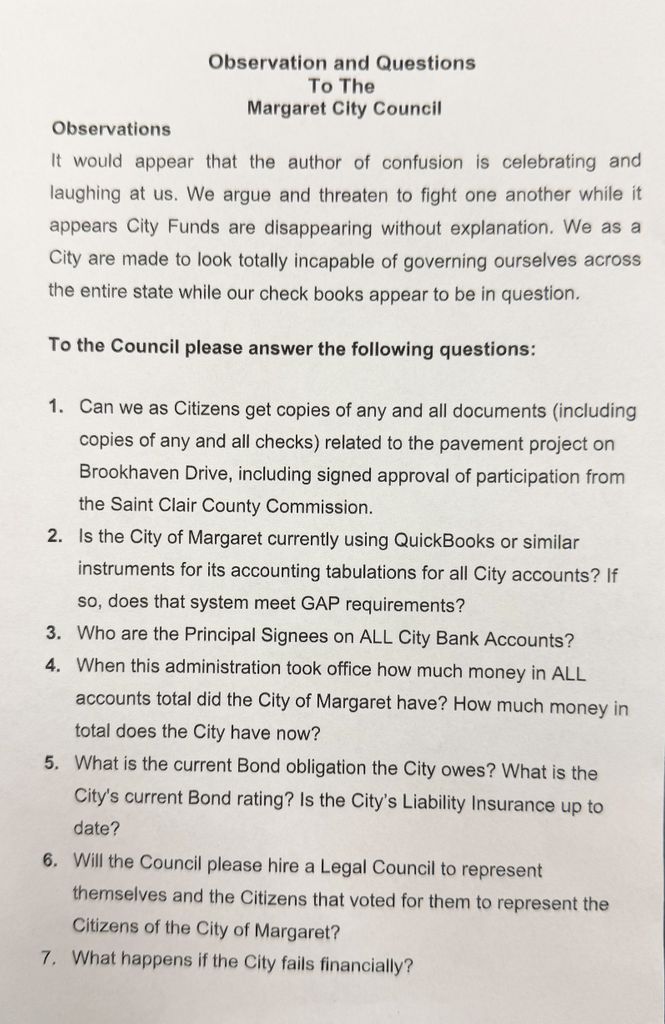
Here are those answers, with links to earlier explanations and supporting information.
1. Can residents obtain the Brookhaven Drive project records?
Yes. Public project records should be available for review, with appropriate redaction of sensitive information.
I have already published the project history in Brookhaven Drive Grant Update, including the grant award, county partnership and payment timeline.
For a fuller understanding of why a payment made this year can relate to an earlier decision, read Part 3: Inherited Obligations vs. New Spending. The date a check clears does not tell you when the obligation was approved.
Brookhaven’s approvals and funding history began before this administration. Paying an invoice during my term does not mean it was part of this year’s budget.
My September FY2027 budget post described an estimated project cost of approximately $616,250, supported by $350,000 in Rebuild Alabama funding. With anticipated county participation covering half the remaining cost, the City’s expected share was approximately $133,125. County reimbursement was still pending when that article was published.
The handout specifically requests signed county approval. That document must be identified separately. An anticipated reimbursement should not be presented as money already received.
The same transparency applies to the Dillard Park Pavilion. Council approved a $203,305 construction bid in June 2025. The September article identified approximately $16,000 in engineering and $6,500 in demolition, bringing those identified costs to approximately $225,805.
The October 19 financial report showed FY2026 reporting categories of $582,088 for Brookhaven and $210,762 for the pavilion. Those are amounts recorded in that year’s reports, rather than certified final project totals.
Residents should be able to follow each project from approval through contract, invoice, payment and reimbursement. Council should be reviewing that same trail before making accusations about the payments.
2. Does Margaret use QuickBooks, and does it meet accounting requirements?
Yes. Margaret uses QuickBooks, with separate books for General Fund and Public Utilities activities.
The handout asks about “GAP.” Assuming the intended reference is GAAP, generally accepted accounting principles, the answer requires more than identifying the software.
Reliable municipal reporting requires proper fund accounting, consistent classifications, reconciliations, internal controls and appropriate year-end adjustments.
I explained the work of organizing the City’s accounts and connecting them to the budget in Building the Foundation. That background helps explain why financial reporting depends on how the system is maintained, beyond which software we use.
The FY2025 audit received an unmodified opinion concerning presentation under generally accepted accounting principles. The FY2026 management reports presented October 19 remain unaudited and identify accounting differences that still need correction.
For the distinction between an audit and a budget, see What the Latest Audit Says About Margaret’s Finances. Each serves a different purpose, and understanding that difference makes the reports easier to evaluate.
Council receives detailed financial information for oversight monthly. Receiving it carries a responsibility to read it, ask specific questions and follow through.
I addressed that responsibility in When Sharing Everything Isn’t Enough. Providing records is part of transparency. Meaningful oversight requires engagement with those records.
3. Who can sign on City bank accounts?
Currently, I am the City’s only authorized bank signer. The City Clerk also serves as a signer, but we do not currently have a clerk.
That leaves the City without a second authorized signer. Council has not completed the work necessary to fill the clerk position or addressed additional signing authority during the vacancy.
This is a practical financial control issue. Payroll, vendor payments and essential operations still have to continue. Depending on one person’s availability creates an avoidable weakness that Council should help resolve.
I discussed the vacancy and its effect on employees in City Clerk Vacancy. Our employees continue carrying the responsibilities of City Hall while the appointment remains unresolved.
Council needs to complete the clerk appointment process and address appropriate additional signing authority, with clear safeguards and the required bank documentation.
Residents are right to ask who can sign. They should also ask Council why this gap remains unresolved.
4. How much money did the City have when this administration began, and how much does it have now?
The October 19 financial report provides the updated comparison:
| Bank snapshot | Amount |
| November 3, 2025 reconstructed closing balances | $6,653,975.57 |
| October 19, 2026 displayed bank balances | $4,359,945.04 |
| Decline between those snapshots | $2,294,030.53 |
The beginning figure covers 26 Truist accounts. The October figure combines Metro posted balances with Truist available balances.
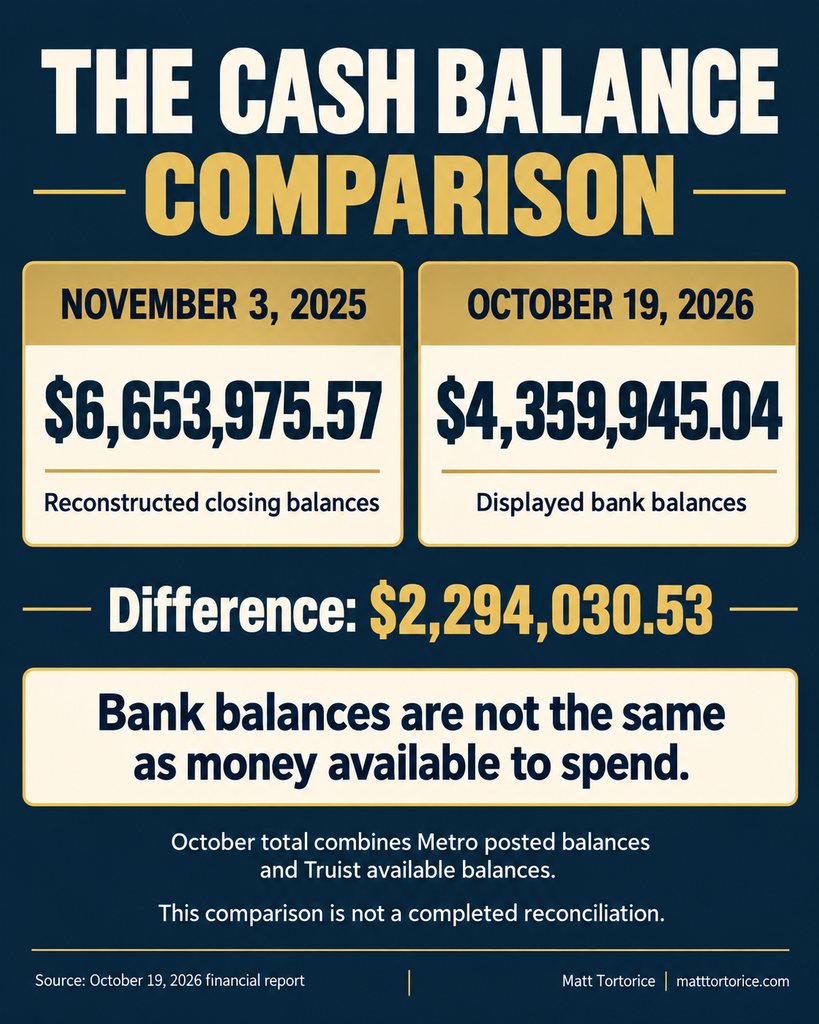
This is a comparison of bank snapshots. It is not a completed reconciliation or a calculation of money available for new spending.
The same report identifies approximately $2,260,007 in annual discretionary spending categories: $1,637,891 in General Fund and $622,116 in Public Utilities.
That amount is close to the cash decline. But the reporting periods differ, and individual transactions still need to be matched before anyone attributes the entire decline to those categories.
Some payments satisfied obligations approved before this administration. Others represent capital purchases or debt repayment. Each needs to be connected to its approval, funding source and payment record. A reporting label alone does not establish when Council approved a particular expense.
Before drawing conclusions from a change in bank balances, read Part 2: Revenue, Transfers and Reconciliation. It explains how transfers and accounting classifications affect the financial picture and why those movements must be reconciled.
Part 5: Understanding Margaret’s Financial Growth provides an earlier account of reserves, inherited obligations and capital spending. The October 19 report supplies the newer comparison.
A declining balance deserves explanation. Declaring that money is “disappearing” requires evidence beyond comparing two totals.
Council cannot fairly question the reduction in reserves without also examining the projects, purchases and obligations it approved.
5. What are the City’s bond obligations, payments, rating and insurance status?
The existing debt-service schedules show two general obligation warrant issues:
| Issue | Scheduled principal remaining as of October 19, assuming scheduled payments were made | Final maturity |
| Series 2017 | $1,640,000 | September 2035 |
| Series 2021 | $5,095,000 | December 2051 |
| Total | $6,735,000 |
Principal is the borrowed amount still owed. Future interest is additional. These figures concern the two warrant issues and do not include a new apparatus lease or every other City obligation.
For FY2027, the schedules show approximately $366,644 in combined principal and interest payments.
The Series 2017 trustee notice calls for regular monthly deposits of $17,826.04 from October 2026 through August 2027. The Series 2021 schedule shows payments of $83,940.63 in December 2026 and $68,790.63 in June 2027.
Deposits into a warrant fund and payments to investors are parts of the same debt-service process. They should not be counted twice.
The original Series 2021 offering document lists an underlying S&P rating of A- and a BAM-insured rating of AA. Those are distinct ratings. The original document establishes the ratings at issuance; current confirmation is needed before representing them as unchanged today.
As to liability insurance, the City maintains coverage. But maintaining a policy does not excuse decisions that could create coverage problems.
I previously described the sequence of events and my concerns in When Politicians Play Games, the Taxpayers Get the Bill. That account provides the context behind my request for Council to explain its September 21 action concerning the former clerk while employment claims remained pending.
My published account describes prior warnings and the lack of consultation with the attorney defending the City and AMIC before that action.
That deserves an explanation from Council. So does the recording discussing a “deal” and putting the mayor in a bind.
The pending employment allegations remain allegations. Their merits belong in the appropriate process. Council’s responsibility to protect the City applies regardless of those allegations.
I have not received confirmation that cancellation was imminent. My concern is that Council acted despite known legal and insurance questions, potentially exposing taxpayers to costs that coverage might not absorb.
The public deserves to know what Council considered, whom it consulted and why it believed its action protected Margaret.
6. Why hasn’t Council obtained separate legal representation?
Council has already authorized spending for outside counsel.
On August 3, 2026, Councilman Jonathan Ray moved to authorize up to $400 per hour for outside legal counsel representing Council. The motion authorized an hourly rate without selecting an attorney. Residents can review the motion, discussion and roll-call vote in the meeting recording.
That leaves a straightforward question: What has Council done with the authority it already approved?
As of October 19, I had not been provided an engagement agreement or notice identifying an attorney retained under that authorization. That describes the information available to me; Council should clarify whether a selection or engagement has occurred.
I support Council obtaining qualified legal advice through a transparent process with a defined scope, reasonable fees and appropriate review of potential conflicts.
Residents deserve to know which attorneys were considered, what work was proposed, what spending limit applies and who is responsible for completing the selection.
An hourly rate alone does not establish the total potential cost. Any engagement should also identify how expenses will be authorized, monitored and reported.
Council should provide an update on what it has done since August 3 and what remains necessary to complete the process.
Council authorized this expense because it said separate representation was needed. Following through, or publicly explaining why its plans changed, is a reasonable expectation of the elected officials who approved it.
7. What happens if the City fails financially?
Residents experience the consequences first.
Financial distress can mean deferred road repairs, postponed equipment replacement, reduced services, difficulty retaining employees and fewer resources for emergencies.
Severe distress can require debt restructuring. Municipal bankruptcy has specific eligibility requirements and is not an automatic consequence of a falling bank balance. The U.S. Courts’ explanation of Chapter 9 describes that process.
The October 19 bank snapshot alone does not establish insolvency. It also does not establish that every dollar is available to spend.
The financial risks deserve serious attention. The year-end reports show expenses exceeding income, substantial additional spending and unresolved accounting differences. My administration has a responsibility to finish that accounting work and explain the results.
Council must examine its own decisions with the same seriousness.
The pavilion commitment illustrates the issue. A construction bid is only part of a project’s cost. Engineering, demolition, maintenance, insurance and competing needs also belong in the decision.
In Planning for Margaret’s FY2027 Budget, I explained why major commitments need a funding plan that accounts for future costs and competing priorities. I believe the pavilion commitment warranted a fuller discussion of those considerations.
Personnel decisions create continuing costs beyond wages. Equipment decisions create maintenance and replacement obligations. Repeated special meetings can create additional staff costs. Decisions affecting litigation can create legal expenses and insurance exposure.
Every proposal should identify its full cost, funding source, effect on reserves and consequences for other priorities.
Fire apparatus financing deserves that same scrutiny.
I presented an approach intended to address apparatus and an additional fire station together. Residents should receive a comparison of that proposal and the financing Council approved, including annual payments, total repayment, financing costs and the facilities or equipment each option would provide.
My preference is for decisions supported by that comparison. Council should explain its selection using the proposals, approval record and final financing documents. My concern is that opposition to the mayor has displaced the financial analysis residents deserve.
Every major commitment should be evaluated against available funding, existing obligations and future service needs. Council should explain why its choice serves Margaret better, using the actual financing documents and the alternatives presented.
Public safety is too important, and financing is too expensive, for either to become a contest over who gets a political win.
As long as personal agendas influence decisions about public money, this City’s financial security will remain at risk.
Do the work
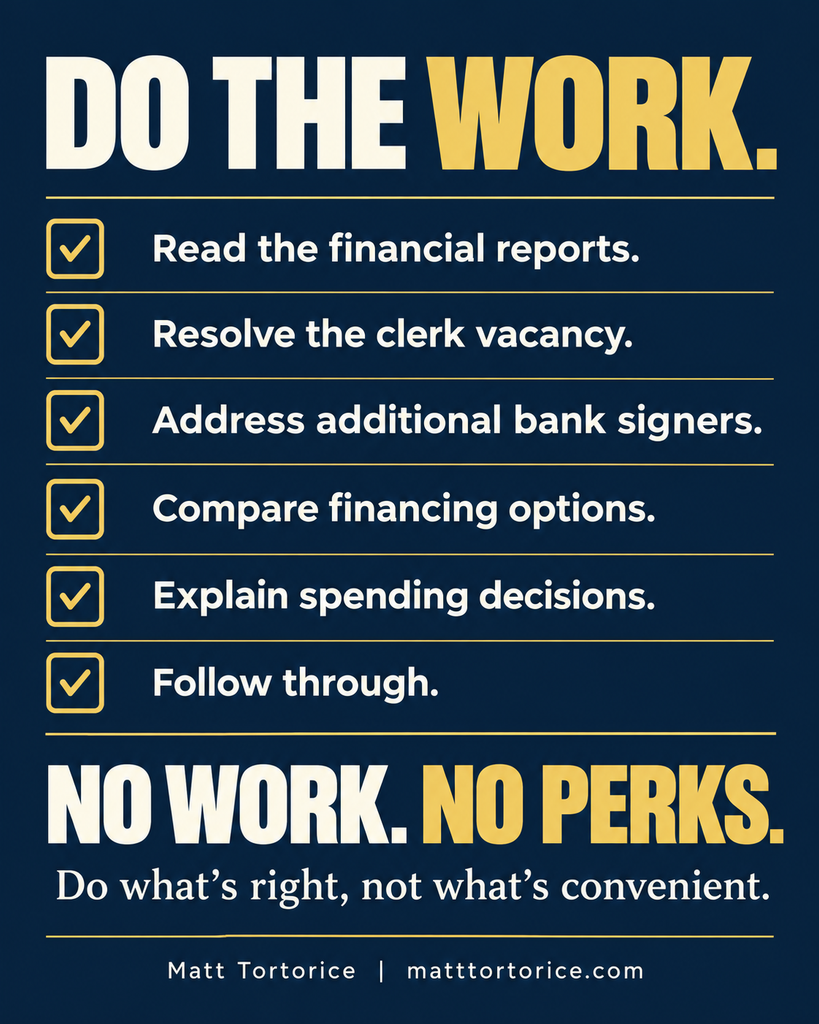
My decisions as mayor should serve Margaret’s interests. I expect residents to evaluate those decisions through the records, the costs and the results.
Disagreement has made some of this work harder. It has not changed my standard:
Do what’s right, not what’s convenient.
I have offered different ways to improve communication and find common ground. I remain willing to cooperate. Cooperation also requires Council members to read the material, prepare for meetings, resolve appointments and explain the financial consequences of their votes.
I will keep working for peace. I am also prepared to challenge decisions, document failures and insist on accountability.
Residents should expect every elected official, including me, to answer questions and show the work behind our decisions.
Public office carries duties. The title, recognition and benefits should come with doing those duties.
No work. No perks.

Leave a Reply