
This past Monday, during a City Council meeting, I asked what sounds like a simple question:
“What’s the deal?”
It wasn’t sarcastic, and it wasn’t rhetorical.
I asked because a recording had surfaced in which people discussed a “deal” involving the former city clerk, talked about putting the mayor in a bind and made the rather colorful prediction that “his ass will be grass.”
I can take the insult. That’s politics.
What concerned me was the word “deal.”
So I asked the council publicly:
Was anyone promised a position, payment or other consideration?
Was anything discussed concerning the pending claims against the City?
Who participated in those discussions?
Who had authority to negotiate or promise anything on behalf of Margaret?
What changed in the City’s position?
What review had been conducted of the legal and insurance consequences before the council acted?
And if there was no deal, everyone had a very easy opportunity to say so.
I received no meaningful answers.
The council moved on, ignoring the public who were there to hear the answers.
But the story does not end there.
Today I need to tell the citizens of Margaret about another significant development.
Our City Attorney has submitted his resignation, effective later this month.
And the circumstances surrounding that resignation make those unanswered questions much more important.
This Was Never an Ordinary Personnel Decision
The former city clerk has pending employment claims against the City of Margaret.
She has every right to pursue those claims. I am not going to try an employment case in a Mayor’s Update or on social media. The City has submitted its response and defenses, and those issues belong in the proper legal process.
But the existence of those claims means a decision to return her to office was never an ordinary personnel decision.
The City has attorneys defending it.
The City’s insurance provider is involved.
The City has already taken formal positions concerning the underlying allegations.
There are potential issues involving damages, insurance coverage, confidential information, litigation records, attorney-client communications and access to City systems.
Against that backdrop, the council took action on September 21 to return the former clerk to office.
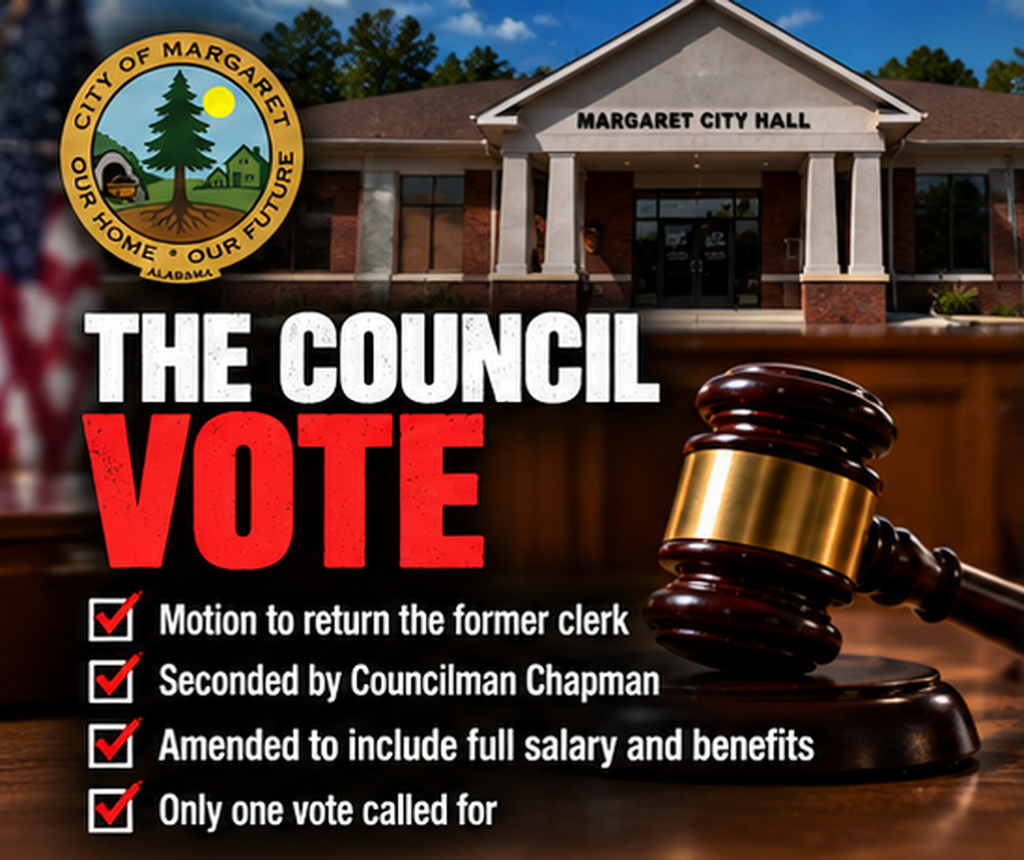
Councilwoman Martrece Bell made the motion. Councilman James Chapman seconded it. Councilman Jonathan Ray raised the question of compensation and the motion was amended to include full salary and benefits. And only one vote was called for.
I was concerned enough about what had just happened that I immediately contacted the attorneys and insurance representatives involved in defending Margaret.
That is what elected officials are supposed to do when a decision could create legal exposure for the City.
You ask questions first.
You determine the risk.
Then you make the decision.
This next part is what makes this so troubling.
The Council Was Not Unaware of the Risk
This is where I have to draw a careful line.
Communications between the City and its attorneys can be protected by attorney-client privilege. That privilege exists to protect the City, not the mayor or any individual councilmember.
I intend to respect it.
I am not going to publish privileged legal advice simply because doing so might make a stronger political argument.
But I can tell the public something important without disclosing the substance of privileged conversations:
This was not a legal concern that suddenly appeared after the September 21 vote.
The potential consequences associated with returning the former clerk while her claims remained pending had already been raised and thoroughly explained to every council member.
There had been warnings.
There were known concerns.
Then despite that, the council acted.
That made the next question particularly important.
Before Voting, Did Anyone Ask the Lawyers?
The day after the council acted, I contacted the attorneys and insurance representatives involved in defending Margaret.
I described what happened and asked whether anyone had consulted them before the council took the action.
I wasn’t asking them to referee a political disagreement.
I wanted to know whether anyone had contacted the people responsible for defending Margaret before making a decision directly affecting someone with an active claim against the City.
The response was clear.
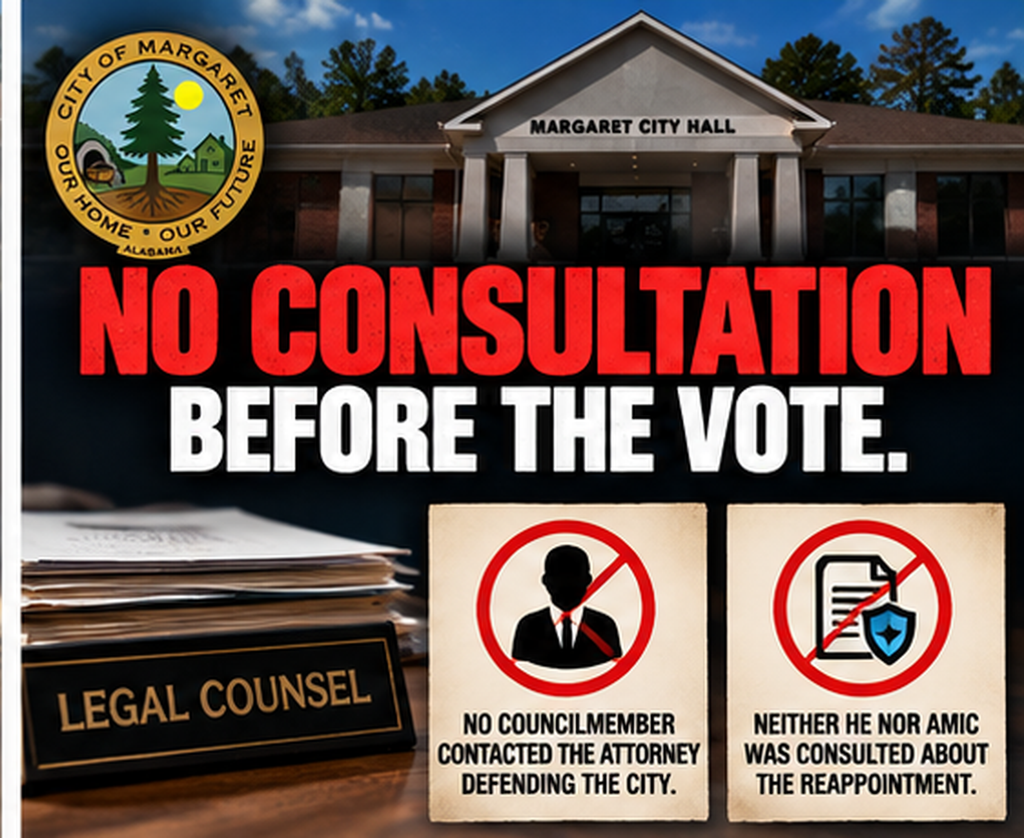
The attorney defending the City in the pending employment matter stated that no councilmember had consulted him about a plan to reappoint the former clerk.
He further stated that he had no reason to believe any councilmember had contacted AMIC concerning the decision.
Most importantly, he confirmed that neither he nor AMIC had been consulted about the reappointment before it happened.
That distinction matters.
This was not a situation where the council sought current guidance from the people defending the City, weighed the consequences and then made a policy decision with which the mayor happened to disagree.
According to the attorney already defending Margaret, nobody on the council consulted him about the reappointment beforehand.
Neither he nor AMIC was consulted.
Why?
I think the citizens of Margaret are entitled to ask that question.
It is especially concerning when some councilmembers have publicly referenced the plaintiffs allegations from the pending EEOC matters during council discussions while simultaneously failing to consult the attorney actually defending the City in those matters.
This Wasn’t the First Time Legal Advice Was Rejected
There is another part of this story that happened during an open council meeting, and I have shared the video.
When Councilwoman Bell made the motion concerning the former clerk, City Attorney Anthony Irwin recommended that Councilman Kerry McIntyre recuse himself because of his family relationship to her.
Kerry’s uncle, the former mayor, immediately questioned that recommendation. Kerry questioned it as well, then chose not to follow the City Attorney’s advice.
He participated in the vote concerning his cousin.
At the following meeting, a citizen raised the issue publicly. Kerry denied that he had voted for her, and Councilwoman Bell joined him in disputing the citizen’s account.
Fortunately, nobody has to rely on anyone’s memory of what happened. Both meetings were recorded. I have placed the relevant portions together below so residents can watch the original motion, hear the City Attorney recommend recusal, see what happened during the vote and then hear what was said about that vote at the following meeting.
I am not asking anyone to take my word for it. Watch the video and decide for yourself what happened.
I have preserved the relevant video from both meetings together so residents do not have to rely on my recollection.
You can watch the motion.
You can hear the City Attorney recommend recusal.
You can watch what happened next.
And you can hear what was said at the following meeting.
I am not going to use this article to declare what legal or ethical conclusion should follow from that sequence.
People can watch it themselves.
But it matters to the larger issue.
Elected officials are not required to blindly follow everything an attorney says.
Attorneys advise. Elected officials decide.
But if an attorney identifies a potential conflict in the middle of a public meeting and recommends recusal, that deserves serious consideration.
And if an elected official chooses not to follow that advice, he should be prepared to own the decision afterward.
The video speaks for itself.
Then Our City Attorney Resigned
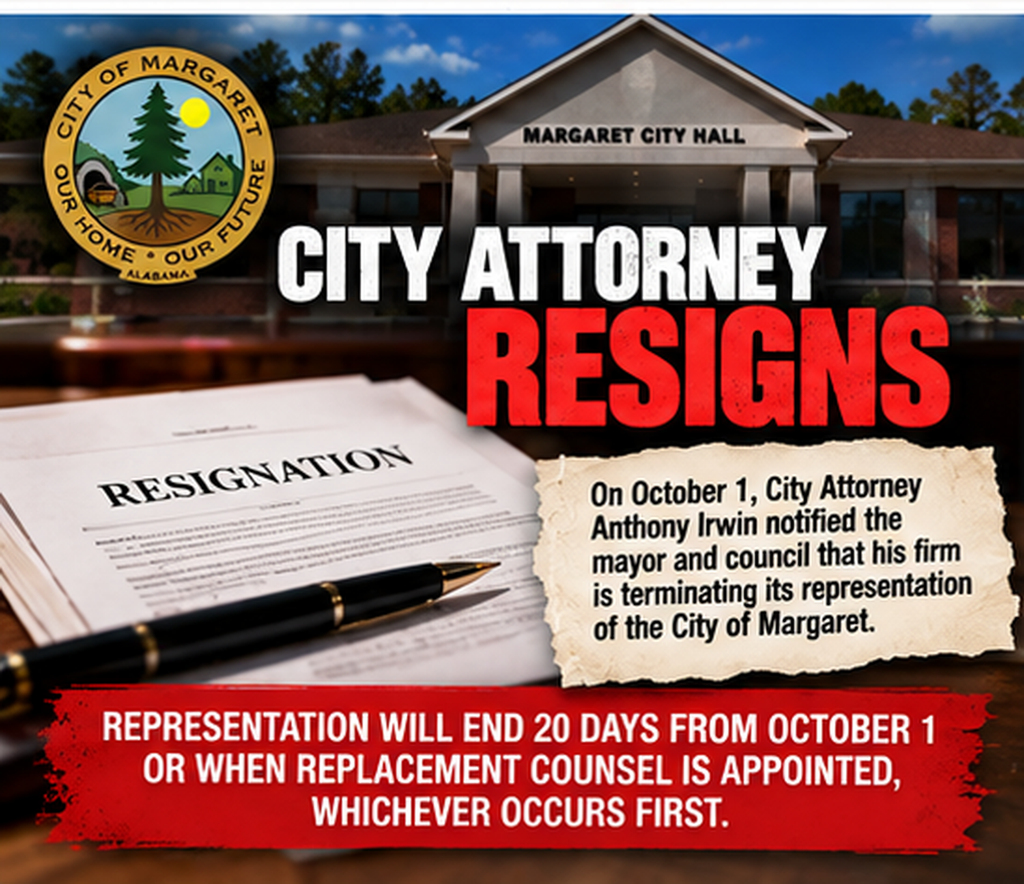
On October 1, City Attorney Anthony Irwin notified the mayor and council that his firm was terminating its representation of the City of Margaret.
His notice states that the representation will end 20 days from October 1 or when replacement counsel is appointed, whichever occurs first.
I do not take that lightly.
Anthony and I have disagreed before. There have been occasions when I did not follow his recommendation, something he himself acknowledges.
I have also followed his advice many times when my own instincts told me to take a different approach. When counsel believed a compromise might lower the temperature or help restore some degree of working relationship at City Hall, I usually tried it.
That is part of governing.
Attorneys advise.
Elected officials decide.
And elected officials ultimately own the consequences of those decisions.
What concerns me is not simply that legal advice was rejected.
What concerns me is the combination of known legal risk, a pending claim, a decision affecting that claimant and no consultation with the attorney actually defending Margaret or AMIC before taking the action.
I also want to treat Anthony and his firm fairly as they leave their representation of Margaret.
His correspondence is marked as an attorney-client communication. I will respect that privilege and will not publish legal advice simply because portions of it might support my position.
What I can responsibly tell the public is that his resignation followed this episode.
I appreciate Anthony Irwin and his firm’s service to Margaret. Not many attorneys would willingly walk into some of the situations we have asked them to handle over the past year.
The resignation of our City Attorney is significant.
It deserves more than a shrug and another agenda item.
Then Came “Damage Control”
There is another moment from our most recent meeting that deserves attention.
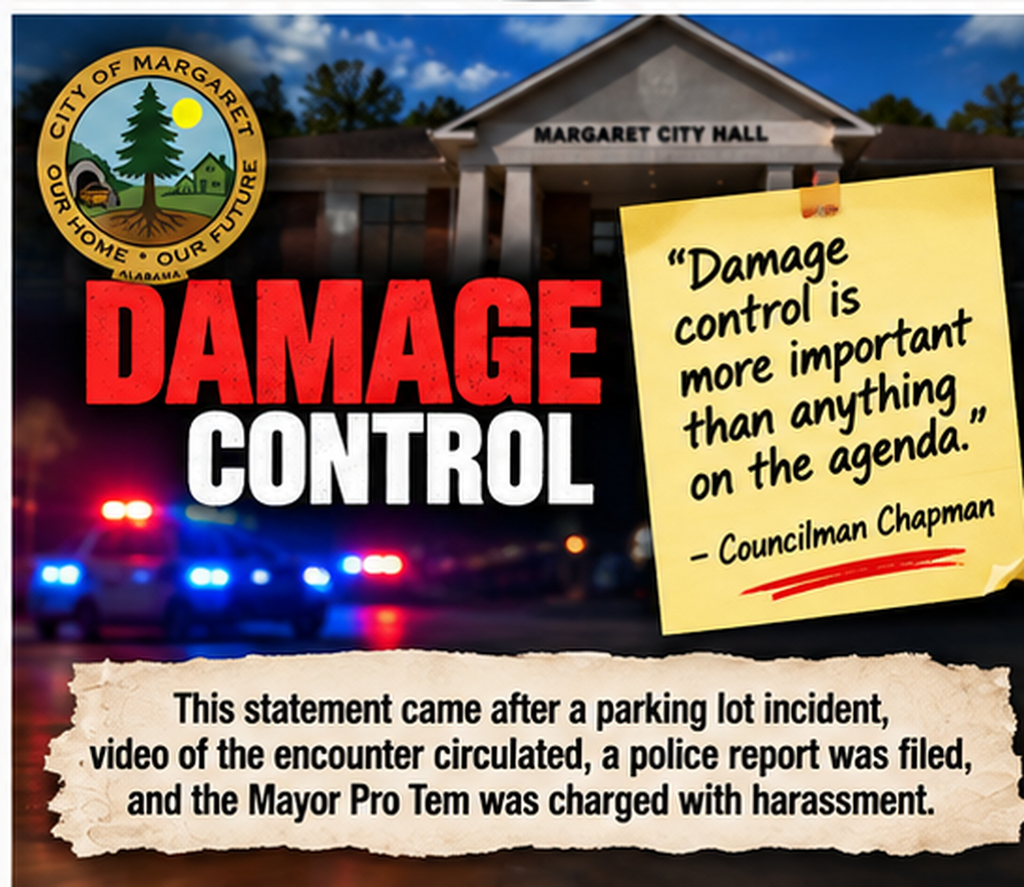
Councilman James Chapman told Councilwoman Bell and Mayor Pro Tem Ray that “damage control” was more important than anything on the agenda.
I want to be very clear about the context because context matters.
He was not talking about the former clerk.
He was talking to them in the aftermath of what happened in the City Hall parking lot following a council meeting.
Video from that encounter circulated publicly. Residents said Councilman Ray confronted and insulted them. One resident filed a police report. Ray was later charged with harassment and booked into the St. Clair County Jail before being released on bond.
That is the context in which Chapman was talking about “damage control.”
In other words, they were discussing how to deal with the fallout from conduct that had already occurred and had already become public.
And Chapman said that damage control was more important than anything on the agenda.
That statement stuck with me.
Because I agree that Margaret needs damage control.
I just think we have very different definitions of what that means.
To me, damage control means preventing the damage in the first place.
It means not harassing residents in a parking lot.
It means asking the attorneys before making a decision that could affect pending litigation.
It means asking the insurance carrier whether an action creates additional exposure.
It means taking a potential family conflict seriously when the City Attorney raises it.
It means protecting taxpayers before there is a legal bill to pay.
Trying to manage the political fallout after someone has already been caught on video is not the kind of damage control I am interested in. But hear him clearly, they planned outside of a public council meeting how to handle their damage control. They seem to think they can lower their head for a few meetings and this will all blow over and be forgotten. What do you think?
Because I am interested in controlling the actual damage to Margaret, and letting their damage slide is counterproductive.
Now, Back to the Original Question
Now put these events together.
A recording exists in which a “deal” is discussed.
Putting the mayor in a bind is discussed.
“His ass will be grass” is said.
Then Councilwoman Bell moves to return the former clerk.
Councilman Chapman seconds it.
Councilman Ray raises compensation.
The motion is amended to include full salary and benefits.
One vote.
The City Attorney recommends that Councilman Kerry McIntyre recuse himself because of his family relationship to the person involved.
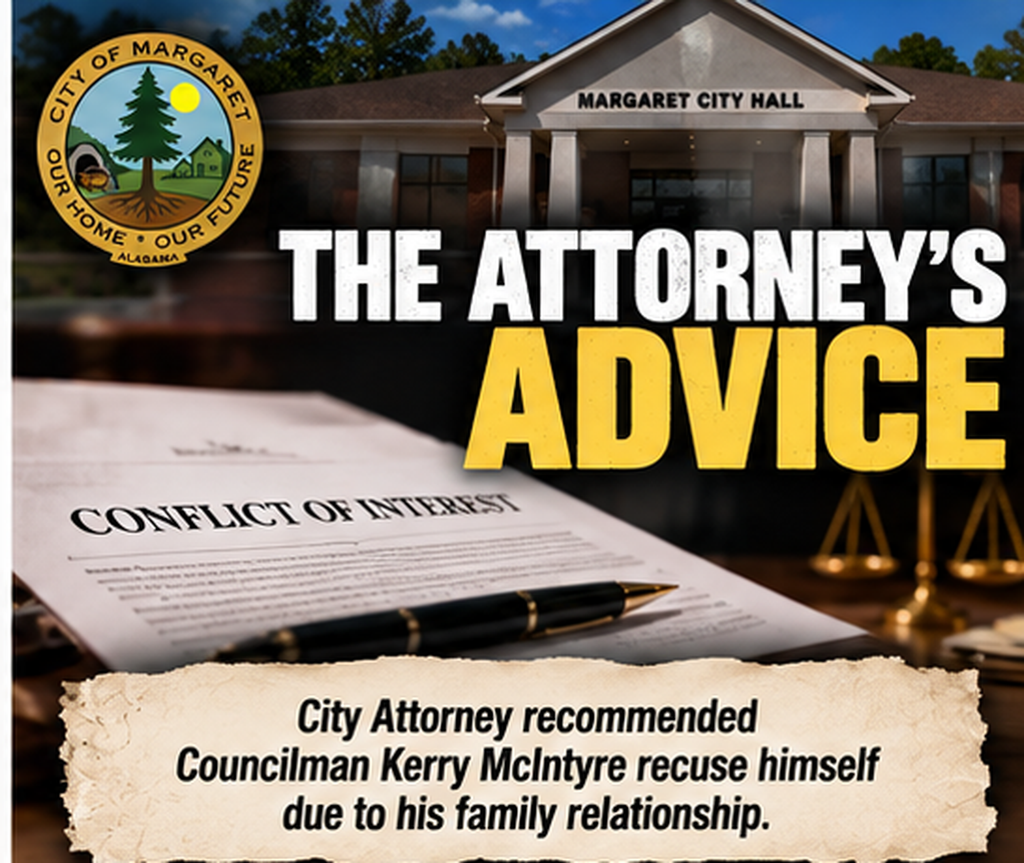
He does not follow that recommendation.
At the following meeting, he disputes having voted for her.
The attorney defending Margaret later confirms that neither he nor AMIC had been consulted about the reappointment before it happened.
Then the City Attorney resigns.
And at the next meeting, after another council controversy has resulted in video circulating publicly and a harassment charge against the Mayor Pro Tem, we hear that “damage control” is more important than anything on the agenda.
That is why I continue asking:
What’s the deal?
I Am Not Going to Guess at Motives
There is a distinction I want to maintain.
I can tell you what happened.
I can show you the videos.
I can document the votes.
I can tell you what questions I asked.
I can show that I contacted the attorneys and insurance representatives afterward.
What I cannot do is tell you what was inside another elected official’s head.
They can explain their own motivations.
If there was no deal, say so.
If nobody was promised anything, say so.
If nobody discussed resolving pending claims in connection with returning the former clerk, say so.
If the council believed returning her with full salary and benefits was in Margaret’s best interest, explain why.
If there was a reason not to consult the attorney already defending the City or AMIC before acting, explain that.
That is accountability.
And accountability is different from damage control.
Damage control worries about what something looks like after everyone sees it.
Accountability explains what actually happened.
This Is Bigger Than One Lawsuit
There is another part of this that deserves more attention because it could affect far more than one employment claim.
Insurance.
The City of Margaret does not simply write a check for every legal claim that comes through the door. Like other municipalities, we maintain liability coverage so the City and its taxpayers are protected when claims arise.
That protection matters.
It is one of the reasons we notify the carrier when something happens that could create liability.
It is one of the reasons the carrier assigns counsel.
And it is one of the reasons elected officials need to think carefully before taking an action that may materially change an existing claim.
Our City Attorney specifically warned that returning the former clerk without first addressing the issue with counsel created potential coverage problems with the City’s insurance provider.
The attorney already defending Margaret also made clear that some of the questions I asked after the council’s action implicated insurance coverage issues that he was not in a position to answer.
That should get everyone’s attention.
Insurance coverage is not automatic simply because the City has a policy.
Coverage can depend on the facts of a claim, the City’s conduct, notice requirements, cooperation with the carrier and the terms of the policy.
I am not saying AMIC has told Margaret that it is cancelling our coverage. It has not, to my knowledge.
But when your own attorneys are telling you that an action may create coverage issues, the responsible response is not to shrug and hope for the best.
You stop.
You ask questions.
You find out exactly what the consequences could be before taking the action.
Because the risk is not limited to whether the City wins or loses one case.
If a carrier determines that some portion of a claim is not covered, the taxpayers may be left paying more of the defense costs, settlement or judgment directly.
If a municipality develops a claims history or repeatedly creates avoidable exposure, that can also affect the City’s future insurance relationship, premiums, deductibles, underwriting and the conditions under which coverage is offered.
And in a worst-case scenario, any municipality that becomes sufficiently difficult or risky to insure can face fewer coverage options and substantially higher costs.
That is why this is such a serious issue.
The council wasn’t spending its own money when it took this action.
It was making a decision that could affect one of the City’s most important financial protections.
And according to the attorney defending Margaret, neither he nor AMIC was consulted before the reappointment.
Think about the sequence.
There was already a claim.
There was already defense counsel.
There was already insurance involved.
There had already been warnings about the risks.
Then the council acted without first consulting the people responsible for defending the City or the insurer potentially responsible for paying the claim.
That is not a minor procedural disagreement.
That is municipal risk management.
And if something goes wrong, the taxpayers are the backstop.
Who Pays If Coverage Does Not?
This is the part every resident should understand.
When elected officials expose the City to liability, they are not risking their personal money.
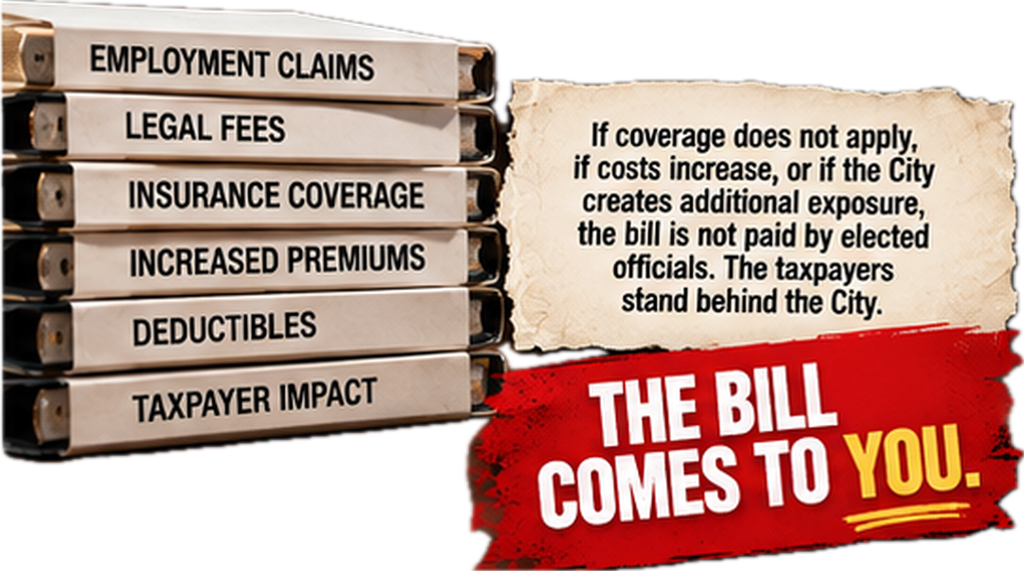
If the carrier pays, the City’s claims history can still matter.
If premiums rise, taxpayers pay.
If deductibles or retained losses increase, taxpayers pay.
If additional attorneys are required, taxpayers pay.
If a portion of a claim is excluded from coverage, taxpayers pay.
If a settlement or judgment exceeds available coverage, taxpayers pay.
If future coverage becomes more expensive or more difficult to obtain, taxpayers pay.
The mayor doesn’t personally write that check.
Neither does a councilmember.
The City does.
Which means you do.
That is why I keep coming back to one basic principle:
Before an elected body takes an action that could materially affect pending litigation or insurance coverage, it should ask the attorneys and the insurer first.
Not afterward.
Before.
That is not politics.
That is basic stewardship of public money.
I Have Tried Not to Turn Every Wrong Into a Lawsuit
There is another side of this that citizens should understand.
During the past year, I have uncovered matters from the previous administration that I believe warrant serious legal scrutiny.
I have preserved evidence.
I have consulted attorneys.
I have considered available legal remedies.
But simply having a potential legal claim does not mean litigation should always be the first response.
Lawsuits cost money even when you believe you are right.
Lawyers cost money.
Discovery costs money.
Employees spend time collecting records, preparing testimony and answering legal requests rather than providing City services.
Ultimately, taxpayers finance that process.
That matters to me.
Where I have believed an issue could be investigated, corrected or resolved without immediately dragging Margaret into another courtroom, I have tried to leave room for that.
That should not be mistaken for an absence of evidence or an absence of legal options.
It is restraint.
But restraint cannot be a one-way street.
City government has the same responsibility not to knowingly create legal exposure that could have been avoided by asking questions first.
That is why this episode matters so much.
I Am Still Asking
My original questions remain unanswered.
Does any written or verbal agreement exist concerning the former clerk’s return or her pending claims?
Who participated in those discussions?
What was discussed?
Was compensation discussed before the meeting?
Was back pay discussed?
Were benefits discussed?
Who had authority to negotiate or promise anything on behalf of Margaret?
What changed between the City’s formal defense of the pending claims and the council’s decision to return the claimant to office?
Why wasn’t the attorney defending Margaret consulted before the council acted?
Why wasn’t AMIC consulted?
Why was the City Attorney’s recommendation that a councilmember recuse himself not followed?
Why was that councilmember’s participation disputed afterward when the meeting was recorded?
And after everything that has happened since, what exactly is the “damage” that Councilman Chapman believes is so important to control that it should take priority over the City’s agenda?
Those are not questions about personalities.
They are questions about public business.
The people paying the bills deserve answers.
Margaret Has to Be Bigger Than This
Margaret cannot be governed as a perpetual contest between the mayor and council.
Every disagreement cannot become an opportunity to get somebody.
Employees cannot become pieces on a political chessboard.
City appointments, lawsuits and taxpayer money cannot become weapons in political fights.
And “damage control” cannot become more important than governing.
I will continue holding myself to the same standard I expect from everyone else.
If I make an accusation, I should have evidence.
If I spend public money, I should be prepared to explain it.
If I exercise authority, I should be able to show where that authority comes from.
If I reject an attorney’s recommendation, I should own the decision.
If I am wrong, I should correct it.
And if I am about to make a decision that could expose Margaret to substantial legal risk, I should ask the people whose job it is to understand that risk before I act.
I expect the same from every member of the Margaret City Council.
Maybe We Really Do Need Damage Control
On one point, Councilman Chapman may be right.
Margaret needs damage control.
But the most important form of damage control happens before something goes wrong.
Protect the taxpayer before creating the liability.
Ask the attorney before taking the vote.
Address a potential conflict before participating.
Treat residents with enough respect that there is no parking-lot video to explain afterward.
Put the City’s interests ahead of the political fight.
And when something does go wrong, own it.
Don’t rewrite it.
Don’t deny what is on video.
Don’t make managing the public reaction more important than fixing the underlying problem.
The attorney defending Margaret says neither he nor AMIC was consulted about the reappointment before it happened.
Our City Attorney has now resigned.
The parking-lot incident became public and resulted in a harassment charge against the Mayor Pro Tem.
And the questions I asked Monday remain unanswered.
If councilmembers want to disagree with me, they can.
If they want to oppose my agenda, they can.
If they want to criticize my decisions, they can.
That’s part of representative government.
But the financial consequences of decisions made at that table do not fall on me personally.
The liability isn’t mine.
The legal bills aren’t paid from my checking account.
A judgment against the City isn’t paid by the mayor.
The taxpayers stand behind the City of Margaret.
So if anyone believed putting the mayor in a bind would somehow hurt only the mayor, there is a fundamental problem with that calculation:
The bill doesn’t come to me.
It comes to you.
Maybe that’s the damage we should have been controlling all along.
Leave a Reply