
In Part 1, we explained why rebuilding the City’s financial structure was necessary before moving forward.
Now we begin looking at the numbers themselves.
But before discussing totals, we need to address something more important:
What actually counts as revenue?
Because not every deposit into a bank account is revenue.
And confusing the two creates an illusion of growth that does not actually exist.
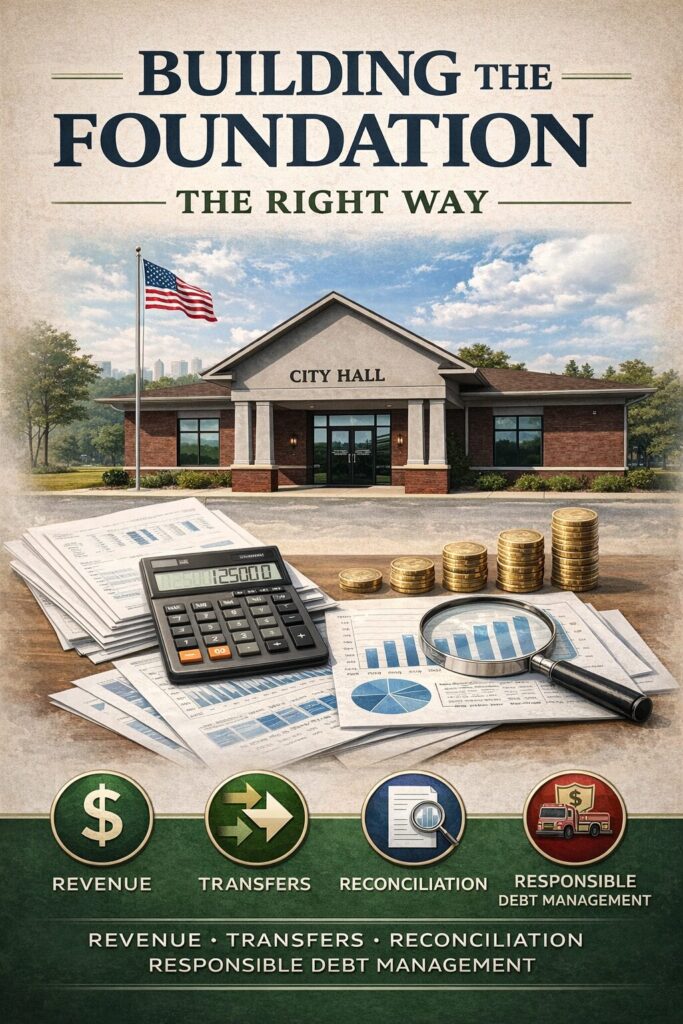
How Revenue Is Properly Classified
In municipal finance, revenue is defined as new money coming into the City from external sources. Examples include:
• Sales tax collections
• Business license fees
• Property tax distributions
• State shared revenues
• Permit fees
• Service charges
Revenue increases the City’s available resources.
But not every deposit increases resources.
Some deposits are simply money being moved.
And that distinction matters.
ACH Credits vs. Manual Deposits
When reviewing year-to-date income activity, we identified two primary forms of deposits:
ACH Credits
Electronic transfers – typically from the State, banks, or tax processors – generally traceable and easier to categorize correctly.
Manual Deposits
Physical checks, in-person payments, or internal deposits recorded manually.
Without consistent coding standards, these deposits were not always classified uniformly. In some cases, clearing activity or internal transfers were coded in ways that resembled operating revenue.
That creates reporting distortion.
Why Inter-Account Transfers Are Not Revenue
If the City moves $50,000 from one internal account to another, the total cash inside City control has not increased.
It has simply been repositioned.
When internal transfers are coded incorrectly as revenue, reports may show “growth” that is actually just money being moved between accounts.
That is not income.
That is reclassification.
When these entries are not segregated properly:
• Revenue totals appear inflated
• Budget comparisons become unreliable
• Department performance becomes difficult to measure
• Cash flow analysis becomes distorted
The new Chart of Accounts corrects this structural weakness.
Bank Fees and Net Collections
Many revenue streams – particularly electronic collections – include processing fees. If gross deposits are recorded as revenue without accounting for those fees, financial reports can overstate actual net income.
For example, if $10,000 is collected but $300 in processing fees is deducted, the City does not have $10,000 in usable revenue. It has $9,700.
In addition to processing fees, the City has also been paying over $1,000 per month in bank fees at our current financial institution – including deposit and account maintenance charges. That is money leaving the City every single month simply to hold our funds.
We are correcting that.
Under the rebuilt financial structure, revenue and fee offsets are clearly separated so net collections are transparent. At the same time, we are restructuring our banking relationships so our public funds are positioned to earn interest rather than incur unnecessary fees.
Our money should be working for the City – not costing the City.
Reconciliation: What Changed
As we began reconciling FY2026 activity, we uncovered prior-period distortions that required correction before current-year reporting could be considered reliable.
One example:
A September transaction exceeding $800,000 was duplicated – recorded both as a transfer and as a check.
In total, the General Fund accounts were out of balance by more than $1,000,000 when reconciliation began.
While our primary focus is FY2026, prior-period entries had to be corrected to ensure beginning balances were accurate.
You cannot build reliable reporting on distorted history.
Reconciliation:
• Matches bank activity to ledger activity
• Separates revenue from transfers
• Removes duplicate transactions
• Corrects classification errors
• Aligns reports with actual cash position
This is not about revising history.
It is about ensuring numbers reflect economic reality.
Financial Obligations We Inherited
In addition to structural accounting issues, we also inherited significant financial obligations:
• Over $500,000 in unpaid, carried-over bills from the prior administration that had to be satisfied.
• A $600,000 fire truck purchase that had already accrued approximately $45,000 in interest before the first payment was made.
Despite having sufficient capital in the bank, the City paid over $40,000 in interest in a single year on that obligation.
The City Council voted to pay off the remaining fire truck balance early.
By doing so, we will save approximately $160,000 in future interest expense.
That decision was not about optics.
It was about financial stewardship.
When capital is available, paying down high-interest debt strengthens long-term stability.
Where the Numbers Stand
General Fund
October 31, 2025:
• Bank Accounts: $4,365,572
• Total Assets: $5,143,643
• Equity: $5,342,481
March 3, 2026:
• Bank Accounts: $3,378,812
• Total Assets: $5,251,291
• Equity: $5,424,282
Change:
• Bank balance decreased by $986,760
• Total assets increased by $107,648
• Equity increased by $81,801
Public Utilities
October 31, 2025:
• Bank Accounts: $2,754,077
• Total Assets: $3,304,354
• Equity: $2,993,528
March 3, 2026:
• Bank Accounts: $2,645,918
• Total Assets: $2,569,156
• Equity: $2,310,053
Much of the movement reflects cleanup, reclassification, debt management, and prior adjustments – not sudden operational decline.
The Illusion of Growth
In fragmented systems, revenue can appear to increase even when:
• It is simply being transferred internally
• It includes prior-period adjustments
• It includes clearing activity
• It reflects gross instead of net figures
That illusion feels positive in the short term.
But long-term stability requires removing illusion.
Responsible governance means distinguishing:
• New income
• Movement of existing funds
• Accounting correction
• Debt reduction
That is the work we are doing.
Why This Matters
Accurate revenue classification determines:
• Whether spending expansions are sustainable
• Whether hiring decisions are prudent
• Whether grant matching funds are truly available
• Whether reserves are actually growing
• Whether debt reduction is responsible
Without structural clarity, even well-intended decisions become risky.
What You Will See Next
In the coming weeks, we will publish:
• Reconciled year-to-date income totals
• Clear separation between revenue and transfers
• Net collections after fees
• Side-by-side comparisons showing the impact of proper classification
No editorializing.
Just data.
This process is not about criticism.
It is about correction.
Revenue means revenue.
Transfers mean transfers.
Debt is managed responsibly.
Reports mean what they say.
Strong cities are not built on optimistic assumptions.
They are built on disciplined numbers.
And we will continue to show our work.
Leave a Reply