
A six-year review of audited revenue, spending and utility operations
An annual audit is different from a budget.
A budget is the City’s financial plan for the coming year. It estimates how much revenue the City expects to receive and authorizes how much may be spent. An audit looks backward. It reports what was actually received, what was actually spent and what the City owned and owed at the end of the fiscal year.
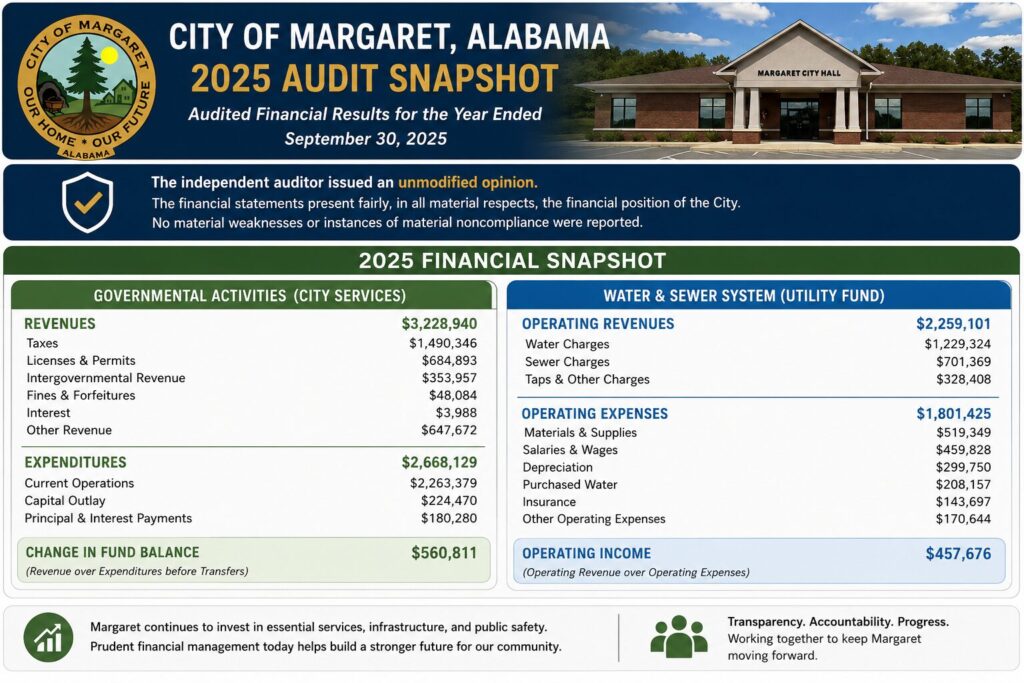
Margaret’s latest audit covers the fiscal year that ended September 30, 2025. The independent auditor issued an unmodified opinion, meaning the financial statements were presented fairly, in all material respects, under generally accepted accounting principles. The auditor also reported that its testing identified no material weaknesses in internal control and no instances of material noncompliance.
The-City-of-Margaret-Alabama-9.30.2025-Audited-Financial-StatementsThat does not mean every decision was perfect or that every process could not be improved. It means the financial statements themselves fairly represent the City’s financial position based on the auditor’s work.
The Simple 2025 Picture
The City has two major sides to its finances.
The governmental funds pay for services such as police, fire, administration, parks, streets and other general municipal operations.
The utility fund operates the water and sewer systems. It is primarily supported by charges paid by utility customers rather than general tax revenue.
During fiscal year 2025:
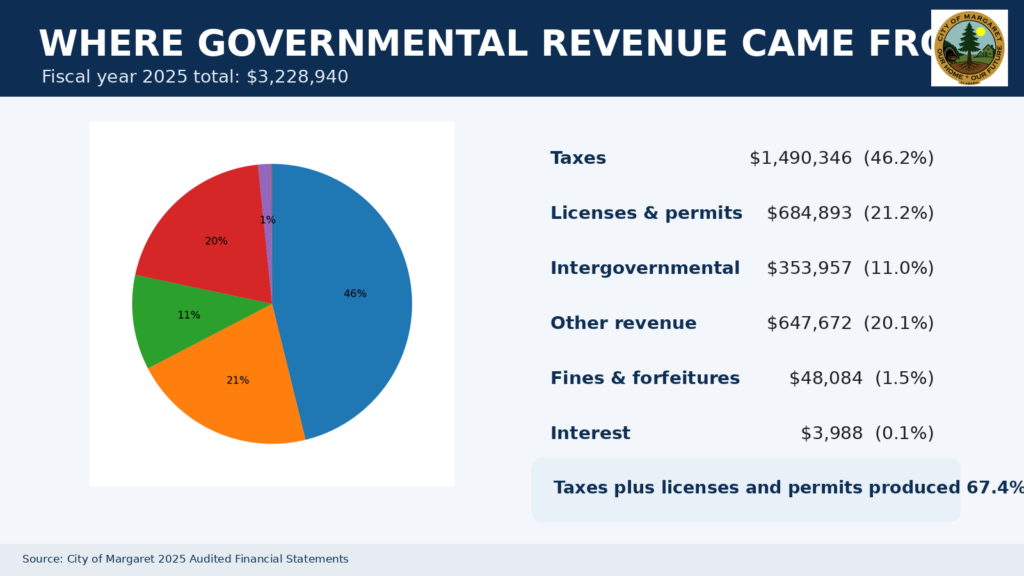
- Governmental funds received $3,228,940 in revenue.
- Governmental funds spent $2,668,129.
- Governmental revenue exceeded expenditures by $560,811 before transfers between funds.
- Water and sewer operations generated $2,259,101 in operating revenue.
- Water and sewer operating expenses were $1,801,425.
- Utility operating revenue exceeded operating expenses by $457,676.
Governmental revenue
| Category | Amount |
| Taxes | $1,490,346 |
| Licenses and permits | $684,893 |
| Intergovernmental revenue | $353,957 |
| Fines and forfeitures | $48,084 |
| Interest | $3,988 |
| Other revenue | $647,672 |
Governmental expenditures
| Category | Amount |
| Current operations | $2,263,379 |
| Capital purchases | $224,470 |
| Principal and interest payments | $180,280 |
Utility revenue
| Category | Amount |
| Water charges | $1,229,324 |
| Sewer charges | $701,369 |
| Taps and other charges | $328,408 |
The largest utility operating expense categories were materials and supplies, salaries and wages, depreciation, purchased water and insurance.
Together, the two sides of City operations produced approximately $5.49 million in audited revenue during 2025 while recording approximately $4.47 million in governmental expenditures and utility operating expenses.
That combined figure is useful as a high-level picture, but the two accounting systems should still be viewed separately. Governmental expenditures include capital purchases and debt payments while the utility operating statement records depreciation rather than treating all capital purchases as immediate operating expenses.
Six Years of Audited Results
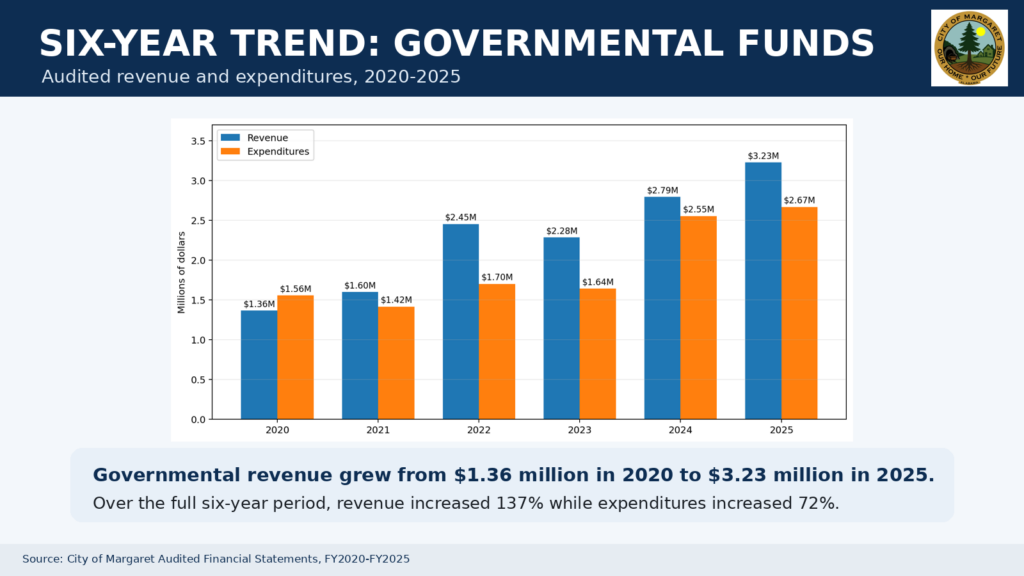
The trend is more important than any single year.
| Fiscal year | Governmental revenue | Governmental expenditures | Utility operating revenue | Utility operating expenses |
| 2020 | $1,364,162 | $1,555,005 | $912,672 | $689,405 |
| 2021 | $1,597,995 | $1,415,514 | $1,071,354 | $713,696 |
| 2022 | $2,454,032 | $1,700,612 | $1,734,143 | $989,425 |
| 2023 | $2,284,395 | $1,641,924 | $2,099,260 | $1,394,594 |
| 2024 | $2,794,578 | $2,553,876 | $2,128,401 | $1,569,782 |
| 2025 | $3,228,940 | $2,668,129 | $2,259,101 | $1,801,425 |
View the 2020-2024 Audited Financial Statements
Governmental Revenue Has More Than Doubled
Governmental revenue increased from $1.36 million in 2020 to $3.23 million in 2025. That represents an increase of approximately $1.86 million, or 137%.
The growth was not perfectly even. Revenue increased sharply in 2022, declined somewhat in 2023 then resumed growing during 2024 and 2025.
From 2024 to 2025 alone, governmental revenue increased approximately $434,000, or 15.5%.
Taxes and licenses remained the City’s two largest recurring governmental revenue sources.
Governmental Spending Has Also Grown
Governmental expenditures increased from $1.56 million in 2020 to $2.67 million in 2025. That represents an increase of approximately 72%.
Spending increased significantly during 2024 as the City invested in capital improvements and debt obligations.
The 2025 audit shows current operations of $2.26 million, capital outlay of $224,470 and debt service of $180,280.
This distinction matters because years with major equipment purchases, infrastructure improvements or debt payments naturally show higher expenditures even when day-to-day operations remain stable.
Public Safety Is Becoming a Larger Part of City Operations
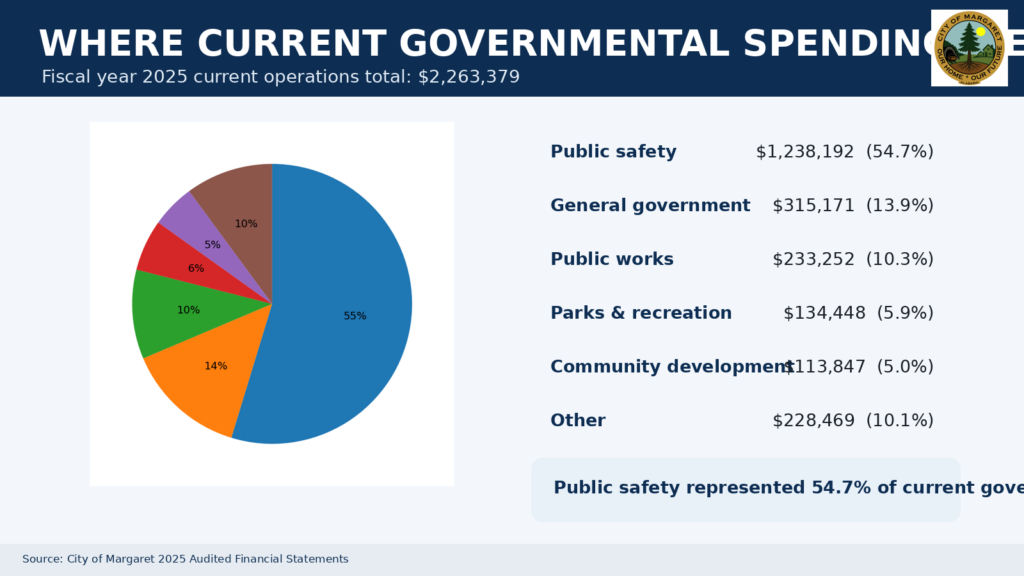
Police and Fire expenditures increased from $531,568 in 2020 to $1,238,192 in 2025. That represents an increase of roughly 133%.
In 2025, public safety accounted for approximately 55% of all current governmental operating expenditures.
As Margaret grows, police, fire and emergency services naturally become a larger share of the City’s operating budget.
The Utility System Has Become a Much Larger Operation
Utility operating revenue increased from $912,672 in 2020 to $2,259,101 in 2025.
Operating expenses increased from $689,405 to $1,801,425 during the same period.
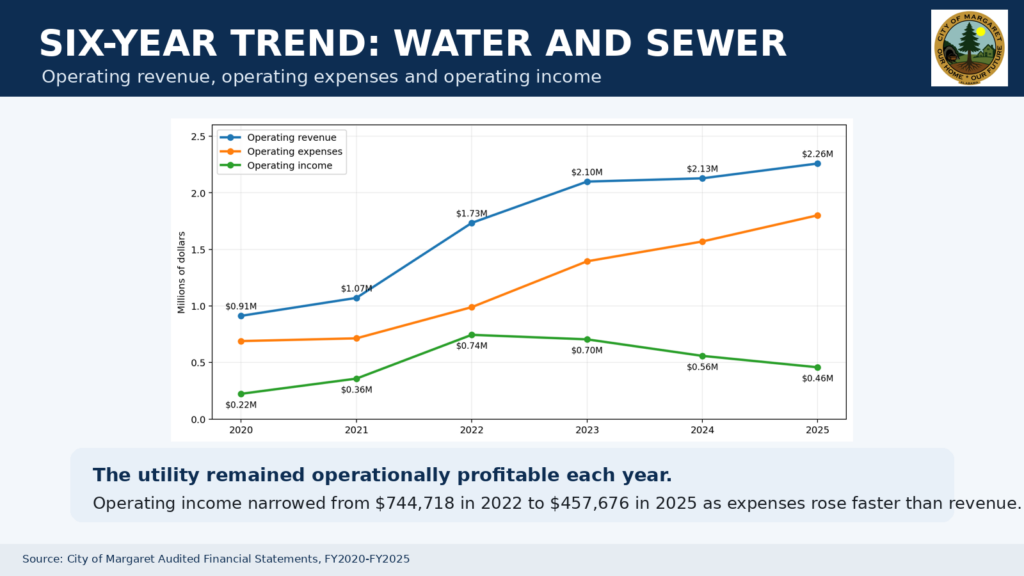
A major turning point occurred in 2022 when Margaret acquired the sewer system. That acquisition significantly increased both the City’s utility assets and its utility debt.
Utility operating income remained positive each year: 2022, $744,718; 2023, $704,666; 2024, $558,619; and 2025, $457,676.
The operating margin has narrowed over the past several years because operating expenses have been growing faster than operating revenue.
That does not mean the utility is operating at a loss. It continues to produce positive operating income. It simply means maintenance, personnel, insurance, materials and debt costs deserve continued attention as the system grows.
How the Audit Compares with the 2026 Budget
The 2025 audit reports what actually happened through September 30, 2025.
The 2026 budget is the City’s plan for October 1, 2025 through September 30, 2026.
The adopted budget anticipates approximately $3.37 million in governmental revenue, approximately $2.19 million in utility-related revenue and continued investment in staffing, public safety, infrastructure, capital projects and debt obligations.
Budgets and audits cannot be compared line-for-line because budgets include transfers between funds. Counting both sides of those transfers would overstate the City’s true revenues and expenditures.
The better comparison is this:
The 2025 audit showed the City entering the current fiscal year with growing governmental revenues, positive governmental fund results and a utility system that remained operationally profitable.
The 2026 budget uses that financial position to continue investing in employees, infrastructure, public safety and long-term capital improvements.
The next audit will tell us how closely actual results matched that plan.
What the Audit Tells Us
The six-year record shows a city that has become substantially larger both financially and operationally.
Governmental revenue has grown faster than governmental expenditures over the full six-year period.
Utility revenue has also grown significantly, although recent expense growth has narrowed operating margins.
The City is collecting and spending more money because it is serving a larger population, maintaining more infrastructure and providing more services than it did just a few years ago.
That growth makes budgeting, monthly financial reporting, fund accounting and long-term capital planning more important than ever.
The audit tells us where we have been. The budget tells us where we intend to go.
Good financial management requires continually comparing the two, explaining the differences and making adjustments before small issues become larger ones.
Source Documents
- City of Margaret Audited Financial Statements, FY2025
- City of Margaret Audited Financial Statements, FY2020-FY2024
- 2026 Adopted Budget Workbook
Leave a Reply