
Last night’s City Council meeting was difficult. But what happened during and after the meeting may say more about where we are as a city than anything that appeared on the agenda.
During the work session, residents confronted members of the council directly about their actions. For much of that discussion, council members chose not to respond, or even look up.
Then came a comment that I believe deserves far more attention.
After residents demanded answers, one council member can be heard saying that “damage control” was the most important thing, more important than anything else on the agenda.
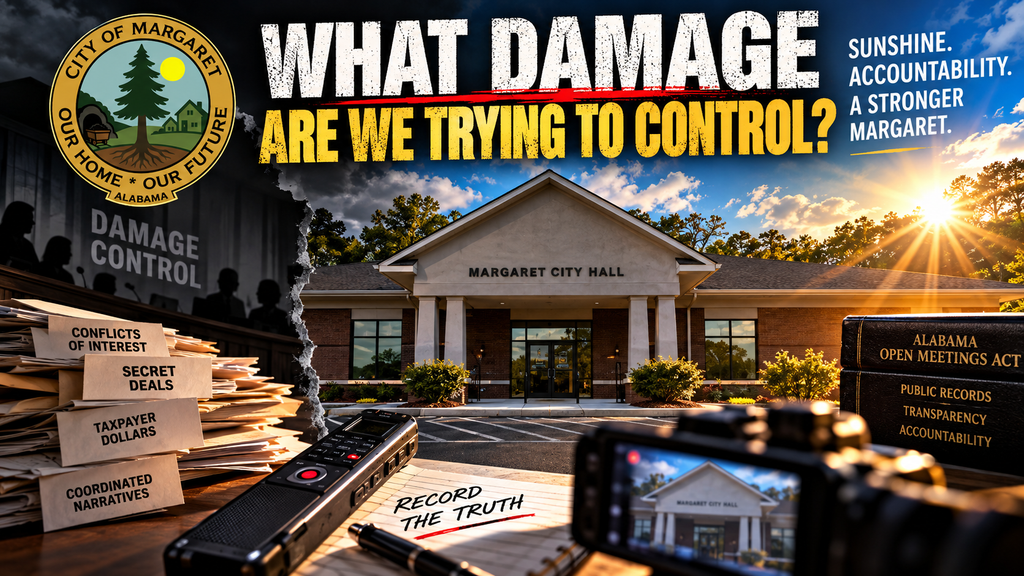
Damage control.
Those words raise an obvious question:
What damage are we trying to control?
If an elected official believes there is damage requiring “damage control,” the public is entitled to ask what damage he was referring to, what caused it and whether the consequences are being borne by the people of Margaret.
Our responsibility is not damage control.
It is public accountability.
Alabama has an Open Meetings Act for a reason. We have public meetings for a reason. We have public records for a reason. Government should operate in the sunshine because secrecy and decisions made outside public view destroy public trust.
Sunshine is not the enemy of good government. It is one of the best disinfectants government has.
And last night demonstrated exactly why.
One citizen raised a specific issue involving Councilman Kerry McIntyre and a previous vote involving a family member. Councilman McIntyre denied that he had voted. Councilwoman Martrece Bell also denied that he had voted.
Fortunately, the public does not have to take anyone’s word for it.
The previous meeting was recorded.
I reviewed the footage and prepared a short video placing the statements from last night beside the recording of the previous vote. Residents can watch both and decide for themselves whether what they were told matches what actually occurred.
That is exactly why recording public meetings matters.
Memories differ.
Political explanations change.
Video does not.
And I believe that same standard should apply to me.
Councilwoman Bell and Councilman Ray have portrayed a previous conversation between Mrs. Bell and me as though I confronted or “cornered” her.
Fortunately, that conversation was recorded too.
Between a special work session and special meeting, Mrs. Bell asked to speak with me. I followed her into the conference room and, because I was concerned about how the conversation might later be characterized, I turned on my voice recorder.
The recording begins with something I believe is important in light of everything that has happened since.
Mrs. Bell tells me that if I allow residents to “come up and belittle us,” I “should stop them from doing it.” She then complains about outbursts from people she describes as being “on your side.”
My response was that nobody should be outbursting and that I was doing my best to control the room.
There is an important distinction here.
As Mayor and chair of the meeting, I have a responsibility to maintain order. That applies to everyone. But maintaining order and protecting elected officials from criticism are not the same thing.
Residents are not “on my side” or “their side” simply because they criticize a council member.
They are citizens of Margaret.
They have a right to question us.
They have a right to disagree with us.
They have a right to demand explanations for our votes and our conduct.
And elected officials should not expect the Mayor to shield them from uncomfortable criticism simply because it is uncomfortable.
The conversation then turned to the relationship between the council and me and eventually to whether Mrs. Bell had received a message I sent asking whether she would attend the meeting.
That portion became heated.
I challenged what Mrs. Bell was telling me. I directly accused her of lying. She strongly disagreed.
You do not have to take my word for any of it.
I am releasing the recording.
Listen to what she says.
Listen to what I say.
Listen to our voices.
Listen to the entire exchange rather than either person’s description of it afterward.
I also want to acknowledge my own conduct.
I sometimes allow myself to be pulled into the same kind of political theater that I criticize. I have made sarcastic remarks. I have responded sharply. During this particular conversation, I directly told Mrs. Bell that I believed she had lied to me.
I do not pretend otherwise.
You can hear it for yourself.
Judge me for it.
If I acted improperly, hold me accountable for it.
But judge what actually happened, not someone’s characterization of what happened.
That is the standard I am asking everyone to apply.
The recording also matters because of what was said afterward.
When I returned to the council chambers, I stated that Mrs. Bell had asked me to have the conversation with her. The recording captures that statement as well.
That sequence matters when the encounter is later characterized as though I sought Mrs. Bell out, confronted her or “cornered” her.
I could give you my interpretation of why the conversation happened. I certainly have one.
But that would defeat the point.
I am not asking anyone to accept my theory about another person’s motives.
I am asking you to listen to the evidence.
I do not have to tell you whether I remained calm if you can hear my voice.
Mrs. Bell does not have to tell you how she conducted herself if you can hear hers.
And nobody who was outside that conference room should be able to substitute a characterization for a conversation that was actually recorded.
The recording is the record.
Listen to it and make up your own mind.
That same principle extends to what happened after last night’s meeting.
Councilwoman Bell left the meeting and became involved in a confrontation with a citizen. A Margaret police officer intervened and separated the parties. The confrontation continued outside City Hall where Councilwoman Bell criticized the officer who had intervened.
This is not something that happened behind closed doors or something I learned about secondhand.
Multiple cameras recorded the incident.
The relevant footage exists. Residents can watch what happened and reach their own conclusions.
I am particularly concerned because this is not the first allegation involving Councilwoman Bell and a confrontational interaction with a resident. Previous incidents involving citizens have been brought to my attention, including an encounter involving Mr. Nappier.
Those allegations should be handled carefully and evaluated based on the evidence available.
Last night requires considerably less interpretation because cameras captured what occurred.
There is a larger principle at stake.
Holding elected office does not place any of us above the people we represent.
A council member does not acquire special status over a resident because he or she sits behind the council table. Residents have every right to question our votes, criticize our decisions and demand explanations from us.
We can disagree with them.
We can correct them when they are wrong.
We can defend ourselves when accusations are unfair.
What we cannot do is treat public scrutiny as though it is an offense against us personally.
Public scrutiny is part of the job.
Last night also included an important discussion about city employees.
I proposed a 5 percent raise for employees after explaining that the new fiscal year had begun and employee raises had been contemplated in the budget.
That proposal failed.
That vote belongs to the council.
So does responsibility for it.
The public is entitled to know how each elected official votes. They are entitled to ask why. They are entitled to compare what an elected official says today with what that official actually did at a previous meeting.
That includes asking how concerns about whether the City can afford employee raises square with other proposals involving substantial expenditures of taxpayer money.
Those are legitimate questions.
That is not privileged information.
That is representative government.
The people do not answer to elected officials. Elected officials answer to the people.
There are also larger questions involving potential conflicts of interest and the relationship between an elected official’s private employment and matters pending before the City.
Those are serious questions and I will not reduce them to social media accusations. They deserve a review based on documents, communications and other evidence. I intend to address those matters separately as the supporting records are assembled and reviewed.
For now, I am going to do something much simpler.
I am going to turn on the lights.
If someone says a vote never happened, show the vote.
If someone says a conversation happened one way, play the conversation.
If someone says a confrontation happened differently, show the cameras.
And when an elected official says “damage control” is more important than anything on the agenda while citizens are demanding answers, do not hide the comment.
Play it.
Then ask the question:
What damage are we trying to control?
Because Margaret does not need damage control.
Margaret needs accountability.
Sunshine may be uncomfortable, but discomfort is not a reason to turn off the lights.
Watch the recordings.
Listen to the audio.
Look at the votes.
Then make up your own mind.
Every elected official in Margaret, including me, should be held to exactly that standard.

Leave a Reply