
Over the last several months, there has been a great deal of discussion surrounding Margaret Fire & Rescue, its operations and the future of public safety in our community.
Unfortunately, much of that discussion has focused on politics and personalities rather than the facts.
The reality is that Margaret Fire & Rescue has made significant progress in a very short period of time.
The department has expanded services, increased training opportunities, pursued grant funding, improved operational readiness and successfully achieved Advanced Life Support (ALS) certification. That accomplishment alone represents a major advancement in the level of emergency medical care available to the citizens of Margaret.
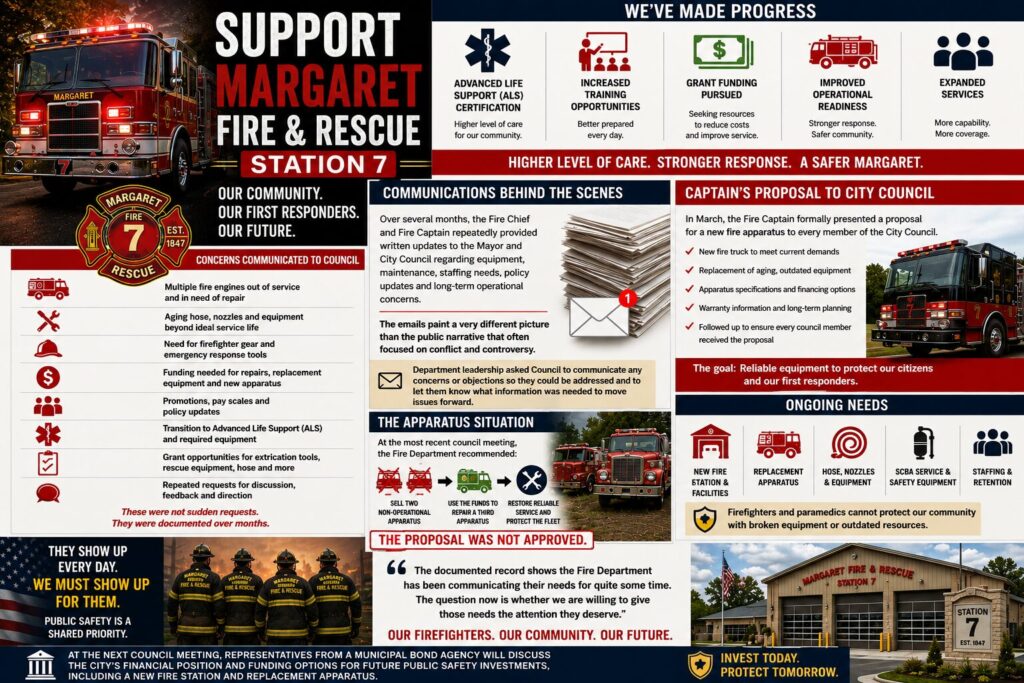
Today, residents have access to a higher level of emergency response capability than ever before.
At the same time, the department has continued operating under significant challenges.
One of the most revealing parts of the public record is not what was said during council meetings, but what was being communicated behind the scenes by department leadership.
Over the course of several months, Fire Chief Brett Thomas and Captain Joshua Davis repeatedly provided written updates to the Mayor and City Council regarding the condition of the department, its equipment, its staffing needs and its long-term operational concerns.
Those emails paint a very different picture than the public narrative that often focused on conflict and controversy.
The Fire Chief consistently reported that the department was operating with aging equipment, limited resources and multiple out-of-service apparatus. He repeatedly requested discussion and action regarding repairs to fire engines, replacement equipment, firefighter staffing needs and policies necessary to operate the department effectively.
Among the concerns communicated to Council were:
• Multiple fire engines that were out of service and in need of repair
• The need to determine whether older apparatus should be repaired, sold or replaced
• Requests to begin planning for the purchase of a new fire engine before the department reached a crisis point
• Aging fire hose, nozzles and equipment, much of which was reported to be beyond its ideal service life
• The need for firefighter equipment, turnout gear and emergency response tools
• Efforts to secure grant funding for extrication equipment, rescue tools, hose replacement and other operational needs
• Requests for approval of firefighter promotions, pay scales and policy updates necessary for department operations
• Updates regarding the transition to Advanced Life Support services and the equipment required to support those services
The concerns raised by department leadership were not limited to the Fire Chief.
Records also show that the Fire Captain regularly communicated with city leadership regarding equipment maintenance, vehicle repairs, apparatus replacement planning, station improvements, firefighter training and operational readiness.
Throughout the first half of 2026, the Captain forwarded repair estimates, maintenance reports, equipment proposals and operational recommendations to city officials. These communications included estimates for repairing department vehicles, annual preventative maintenance on fire apparatus, annual servicing of breathing apparatus equipment, station improvements and equipment upgrades necessary to maintain emergency response capabilities.
In March, the Captain formally presented a proposal for a new fire apparatus to every member of the City Council.
The proposal explained that the department’s goal was to provide firefighters with reliable equipment capable of meeting current emergency response demands and protecting both citizens and first responders. It requested consideration of a new fire truck and replacement of aging equipment that no longer met modern operational needs.
The proposal included apparatus specifications, financing options, warranty information and recommendations for equipment replacement. The Captain even followed up afterward to ensure that every council member had successfully received the proposal.
These communications show a department actively planning for the future while simultaneously trying to maintain the equipment it already had.
In several emails, department leadership specifically asked council members to communicate any concerns or objections so they could be addressed. They repeatedly requested feedback regarding items that had been tabled, delayed or voted down and asked what information was needed to move those issues forward.
The records show that many of these discussions were not sudden requests made at council meetings. They had been communicated through emails, updates, reports and proposals over a period of months.
Perhaps no issue better illustrates this than the department’s apparatus situation.
At the most recent council meeting, the Fire Department presented a recommendation to sell two non-operational fire apparatus and use those funds to repair a third apparatus that mechanics and department leadership believed represented the best path forward.
The recommendation was based on repair estimates, operational needs and practical considerations regarding the department’s fleet.
The proposal was not approved.
Whether someone agrees with every recommendation made by the Fire Chief and Captain is a matter of public policy and debate.
What the records clearly demonstrate, however, is that the department’s operational challenges, equipment needs and long-term planning concerns were regularly communicated to city leadership.
The documented record shows a department attempting to address aging apparatus, equipment shortages, staffing needs and future capital improvements while simultaneously expanding services and increasing capabilities.
That context matters because it helps explain why discussions regarding a new fire station, replacement apparatus, grants and long-term public safety investments have become recurring topics throughout 2026.
These were not issues that suddenly appeared.
They were concerns that had been repeatedly identified and documented by department leadership over time.
Public safety is one of the most important responsibilities of local government.
Firefighters and paramedics cannot protect our community with broken equipment. They cannot continue expanding services without the policies, staffing structures and resources necessary to support those services.
At the next council meeting, representatives from a municipal bond agency will be discussing the City’s financial position and potential funding options for future public safety investments, including a new fire station and replacement apparatus.
Those discussions are important because the needs identified by the Fire Department are not temporary concerns. They are part of a long-term effort to ensure that Margaret continues improving emergency services for years to come.
Regardless of political differences, public safety should remain a shared priority.
The men and women of Margaret Fire & Rescue show up every day prepared to answer the call. They have worked to improve services, increase capabilities and better serve our community.
They deserve the tools, equipment and support necessary to do their jobs safely and effectively.
The documented record shows they have been communicating those needs for quite some time. The question now is whether we are willing to give those needs the attention they deserve.


Leave a Reply